

A five-minute difference doesn’t sound like much.
But when five minutes is repeated across every appointment, every chair, every hygienist, and every working day, it can have a significant impact on a dental practice’s capacity and ultimately its bottom line.
That was the challenge facing one dental office when GWC Consulting examined its hygiene scheduling process.
The Problem:
A Scheduling Bottleneck
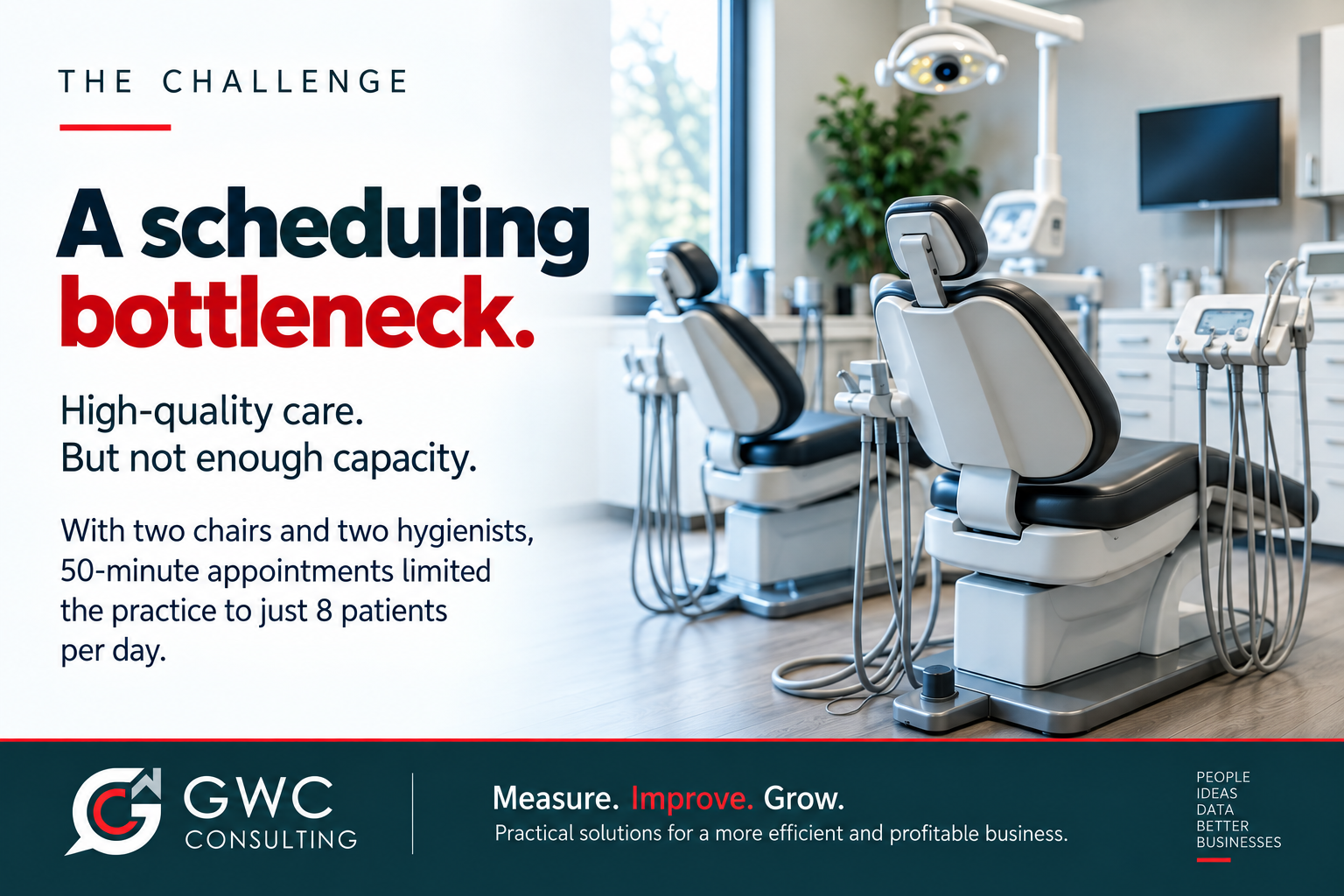
The practice operated two dental chairs with two hygienists providing routine teeth-cleaning appointments.
Each appointment effectively required approximately 50 minutes: about 45 minutes for the hygiene portion of the appointment, followed by approximately five minutes for the dentist to complete the final examination.
On its own, that seemed perfectly reasonable. The problem became apparent when we looked at the process across an entire day.
The length of each appointment limited the number of patients the practice could accommodate. With two hygienists and two chairs, even a relatively small inefficiency was being repeated over and over again.
The question wasn’t whether the hygienists were working hard enough.
The better question was:
Could the same quality of service be delivered through a more efficient process?
Step 1: Measure Before You Manage
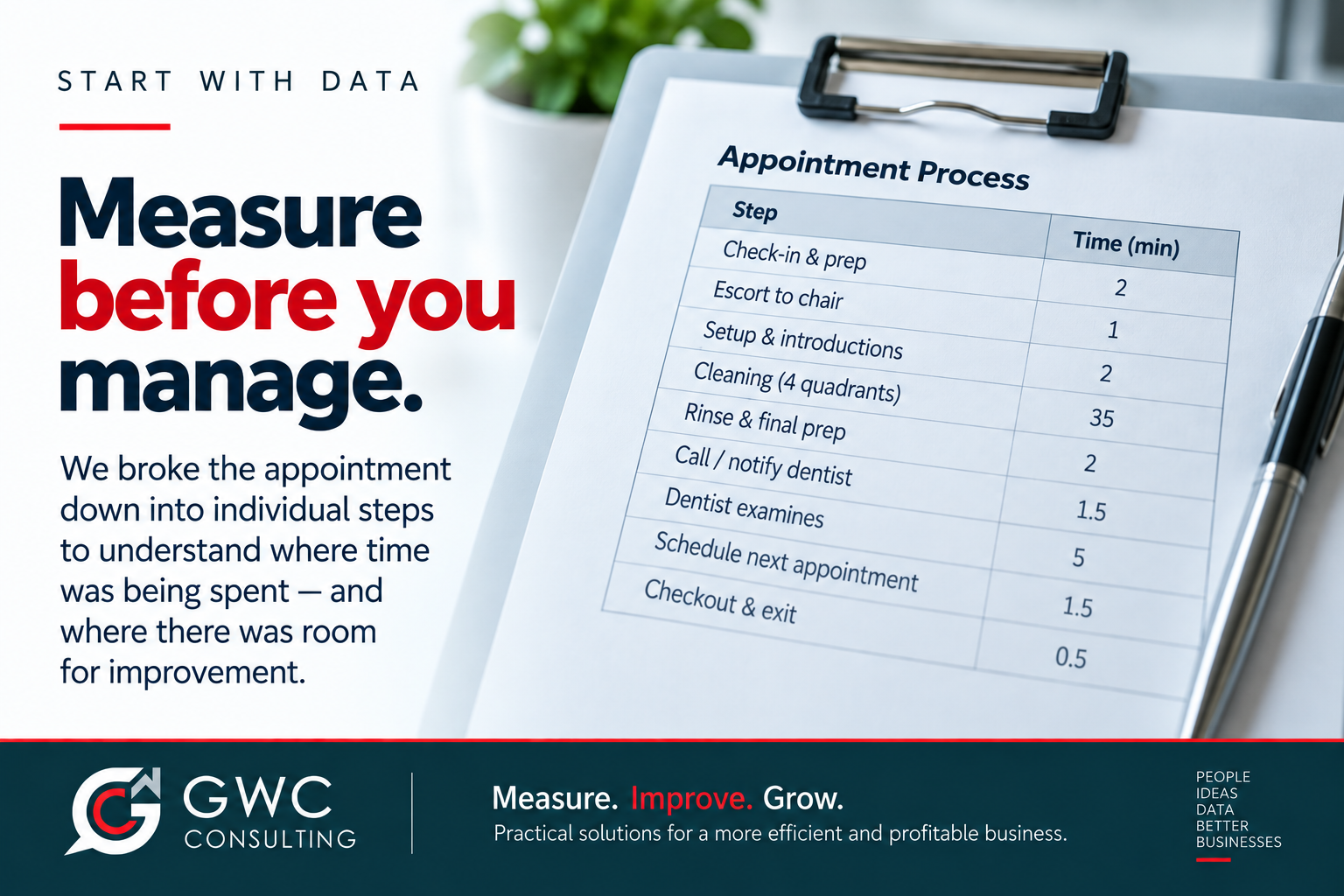
Before trying to change the schedule, we needed to understand what was actually happening during those 45 minutes.
GWC Consulting broke the appointment into its individual components and examined how much time was being spent at each stage of the process.
This is where performance measurement becomes particularly valuable.
Instead of treating a “teeth cleaning” as a single 45-minute activity, we looked at the individual steps that made up the appointment. That allowed us to identify where time was essential to patient care, where processes could be improved, and where minutes were being lost simply because “that’s how we’ve always done it.”
Importantly, the objective was not to rush patients or compromise the quality of care. The objective was to remove inefficiency from the process.
Step 2: Benchmark the Process
Measurement tells you what is happening inside your organization.
Benchmarking adds context.
By comparing the practice’s process and appointment times against appropriate benchmarks, we could ask a much more useful question than simply, “How long does an appointment take?”
We could ask:
“How long should each part of this process reasonably take while maintaining the required standard of care?”
That distinction matters.
If a process takes 45 minutes because 45 minutes is necessary, there may be nothing to fix. If it takes 45 minutes because of workflow, sequencing, administrative steps, or historical practice, there may be an opportunity for improvement.
Step 3: Finding 5-Minutes
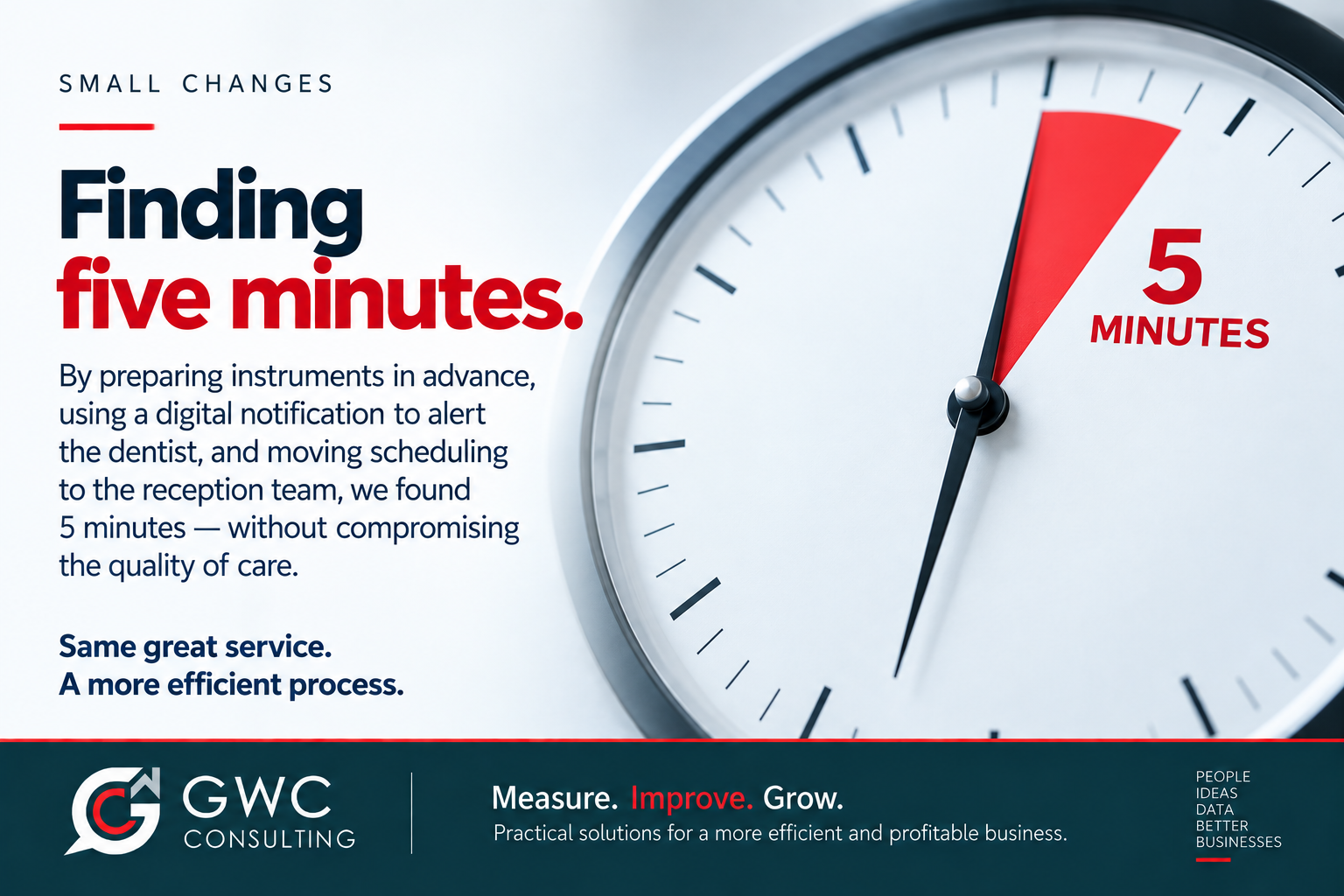
After breaking down and examining the process, we identified an opportunity to reduce the hygiene portion of the appointment from approximately 45 minutes to 40 minutes without reducing the service provided to the patient.
The dentist's five-minute examination remained.
That meant the complete process could move from approximately 50 minutes to 45 minutes.
Five minutes.
That was the improvement.
And viewed in isolation, five minutes sounds almost insignificant.
But businesses don't operate one appointment at a time.
5-Minutes Multiplied
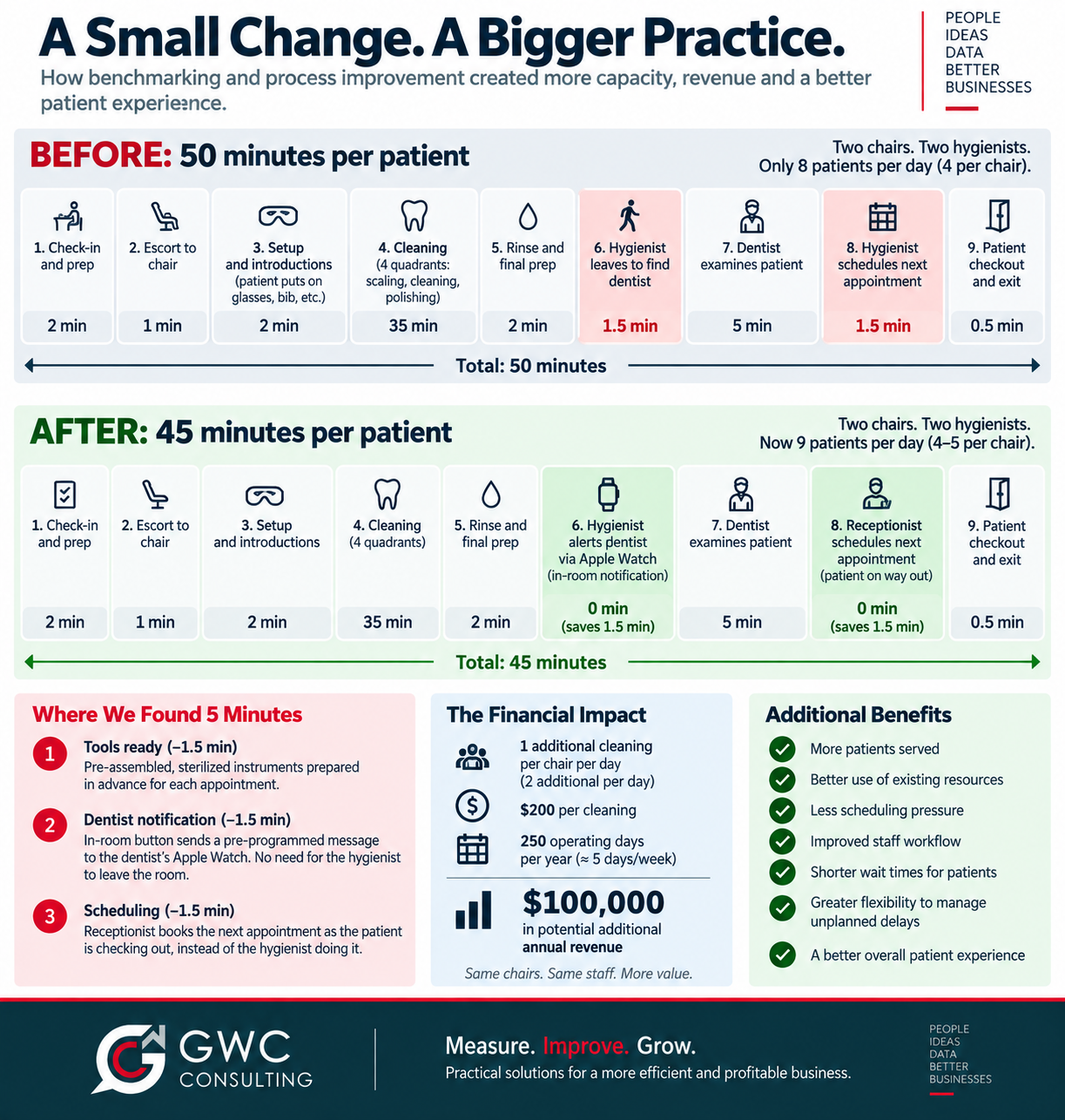
This is where process improvement becomes a financial exercise. Saving five minutes on one appointment saves five minutes. Saving five minutes across every hygiene appointment creates additional capacity.
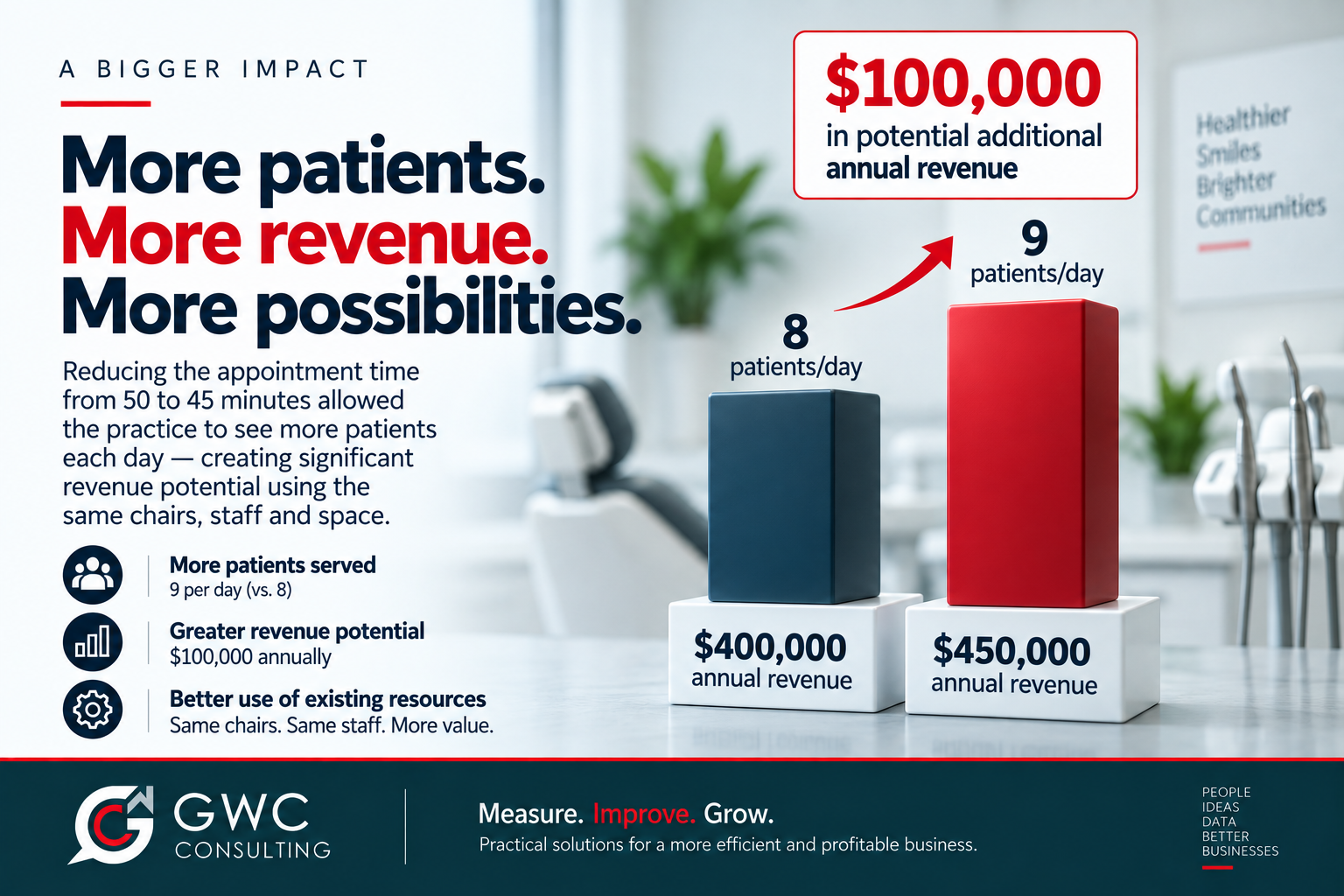
Across two chairs, multiple appointments per day, five days per week and dozens of operating weeks each year, those small increments of time accumulate.
That additional capacity can be used in different ways. The practice may be able to accommodate additional appointments, reduce scheduling pressure, create greater flexibility for patients, absorb delays more easily, or make better use of its existing staff and physical space.
And when demand exists for additional appointments, increased capacity can translate directly into increased revenue—without adding another hygienist, another chair, or additional square footage.
That's the important part. The practice didn't necessarily need more resources. It needed to get more value from the resources it already had.
Take Away Points:
Efficiency Doesn't Mean Working Faster
There is an important distinction between asking employees to work faster and designing a process that allows them to work more efficiently. Simply telling a hygienist to complete an appointment five minutes faster isn't process improvement. Examining the workflow, measuring each component, benchmarking performance, identifying unnecessary steps, and redesigning the process is.
The goal isn't: “Do more work in less time.” It's: “Remove the things that consume time without adding equivalent value.”
“We didn't ask the hygienists to work 10% faster. We removed five minutes of work that didn't require a hygienist.”
What Gets Measured Gets Improved
Businesses often look for large solutions to improve profitability: more customers, more employees, new technology, larger facilities or higher prices.
Sometimes the opportunity is much smaller. It might be hiding in five minutes.
Performance measurement helps organizations understand how their operations are actually performing. Benchmarking provides the context necessary to determine whether there is an opportunity to improve. Process analysis then turns that information into action.
In this case, the formula was straightforward:
Measure the process → Benchmark performance → Identify the constraint → Improve the workflow → Create capacity
The result was a more efficient scheduling model with the potential to serve more patients and generate additional revenue using essentially the same resources. That is what good performance measurement should ultimately accomplish.
Not more spreadsheets.
Better decisions. Better processes. Better results.
GWC Consulting helps organizations measure performance, improve processes, and turn data into practical strategies for growth and operational improvement.
